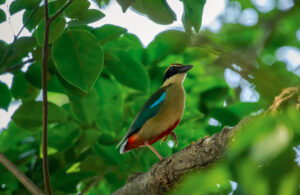
The green breasted pitta guide is essential reading for any birder seeking one of Africa’s most elusive and photogenic forest birds. Found in the lowland forests of Kibale National Park and a handful of other Ugandan locations, the Green-breasted Pitta (Pitta reichenowi) combines spectacular coloration—emerald green breast, cobalt blue wings, and crimson belly—with frustratingly secretive behavior that makes it a true test of patience and skill. This comprehensive guide covers identification, habitat, behavior, best viewing times, and photography techniques essential for successfully encountering this forest jewel in the Pearl of Africa.
The Green-breasted Pitta is one of Africa’s most sought-after bird species. Belonging to the pitta family (Pittidae), a group of colorful, terrestrial birds found across tropical Asia and Africa, this species inhabits lowland and montane forests in central and eastern Africa. In Uganda, Kibale National Park offers the most reliable sightings, though populations also occur in Semuliki and Budongo forests. The combination of spectacular coloration, elusive behavior, and the challenge of viewing makes the Green-breasted Pitta a bucket-list bird for serious birders.
Scientific Classification:
Scientific Name: Pitta reichenowi
Family: Pittidae (Pittas)
Order: Passeriformes
Average Length: 18-20 cm (7-8 inches)
Average Weight: 60-80 grams
Distinctive Features: Emerald green breast, cobalt blue wings, crimson belly
Identifying the Green-breasted Pitta requires attention to its distinctive coloration and behavior.
Distinctive Characteristics:
Breast: Brilliant emerald green, the species’ namesake feature
Head: Rich chestnut crown with black eyestripe and pale throat
Wings: Stunning cobalt blue with black tips on wing coverts
Back: Olive-green to blue-green
Belly: Bright crimson-red extending from lower breast to undertail
Bill: Black, relatively heavy for a pitta
Legs: Flesh-colored to pale pink
Voice: Loud, explosive “chow-chow-chow” or “skyeep” often heard before the bird is seen
Understanding the Green-breasted Pitta’s habitat preferences is crucial for successful sightings.
Primary Habitat:
Lowland and montane moist forest
Dense forest understory with leaf litter
Areas near streams or drainage lines
Forest with abundant fallen logs and dense vegetation
Elevations from 800-2,000 meters
Ugandan Distribution:
Kibale National Park: The premier location, particularly the main track near Kanyanchu and areas around the park headquarters
Semuliki National Park: Reliable population in lowland forest
Budongo Forest: Occasional sightings in this Murchison Falls-adjacent forest
Mabira Forest: Historically recorded but now very rare
Green Breasted Pitta Guide: Best Viewing Locations in Kibale
Kibale National Park offers the most reliable Green-breasted Pitta sightings. Focus on these specific areas:
Main Track (Kanyanchu Area):
The main track from the park headquarters to Kanyanchu River is the most productive area. Pittas emerge onto the track after rains to feed on insects and worms.
Kanyanchu River:
The area around the Kanyanchu River crossing provides dense understory habitat that pittas favor. The combination of moisture, leaf litter, and insects attracts birds.
Bigodi Wetland Sanctuary:
The forest edges of Bigodi, adjacent to the national park, occasionally produce sightings, particularly after rains.
The Green-breasted Pitta’s behavior explains both its appeal and its elusiveness.
Feeding Habits:
Terrestrial forager, hopping on forest floor
Feeds on insects, worms, snails, and small invertebrates
Flips leaf litter with its bill to expose prey
Often follows army ant swarms to capture fleeing insects
Most active after rains when insects emerge
Behavioral Patterns:
Generally solitary or in pairs
Secretive, spending most time in dense understory
Most active during early morning and late afternoon
Emerges onto trails after rains—the best viewing opportunity
Responds to playback, which can be used judiciously for sightings
Flies low and fast when disturbed, often disappearing into dense cover
Breeding:
Breeds during dry seasons (December-February, June-August)
Builds dome-shaped nest on ground or low branches
Clutch size 2-3 eggs
Timing is critical for Green-breasted Pitta viewing. This green breasted pitta guide outlines optimal conditions.
After Rains:
The single most important factor for sightings is rain. Pittas emerge onto trails and open areas after rainfall to feed on exposed insects and worms. A morning after an overnight rain is ideal.
Dry Season (December-February, June-August):
While the dry season offers better trail conditions, the best sightings often occur during light rains or immediately following rain events.
Morning Hours (7:00-10:00 AM):
Birds are most active in the morning hours, particularly after rain. Late afternoon can also be productive.
Specific Conditions:
After overnight rain, focus on trails from 7:00-9:00 AM
Light drizzle often brings pittas onto open areas
Overcast days with occasional light rain extend feeding windows
Avoid heavy rain, which keeps birds under dense cover
To maximize your chances of seeing this elusive species:
Visit after rain—pittas emerge onto trails to feed following rainfall events
Start early—morning hours (7:00-9:00 AM) offer best viewing opportunities
Work with experienced guides—Kibale guides know specific territories and recent sightings
Walk quietly—pittas are sensitive to noise and movement
Watch trail edges—birds often emerge from dense cover onto open trails
Listen for calls—the distinctive “chow-chow-chow” often precedes sightings
Be patient—pittas may remain hidden for extended periods then suddenly appear
Capturing the Green-breasted Pitta is a challenge that rewards preparation.
Recommended Equipment:
400-600mm telephoto lens for distant subjects
Fast lens (f/2.8 or f/4) for low-light forest conditions
Camera with excellent high ISO performance
Beanbag for ground-level shooting
Rain cover for equipment
Photography Techniques:
Shoot from low angle at bird’s level
Use aperture priority with wide aperture for subject isolation
Focus on the eye; accept some foliage in the frame
Be ready for brief appearances; birds may only show for seconds
Wait patiently at known territories after rains
Use natural light; flash is disruptive and often ineffective in forest conditions
The Green-breasted Pitta is classified as Least Concern on the IUCN Red List, though forest loss remains a concern.
Threats:
Forest fragmentation from agricultural expansion
Habitat degradation from selective logging
Climate change affecting rainfall patterns
Conservation Efforts:
Kibale’s protected status provides core habitat
Forest corridor conservation programs
Sustainable tourism supports habitat protection
Population Trends:
Populations are stable within protected areas like Kibale but declining in unprotected forests.
What is the best time of year to see Green-breasted Pitta?
The dry seasons (December-February, June-August) offer the best conditions, but sightings are most likely after rains regardless of season.
How long does it take to see Green-breasted Pitta?
With an experienced guide and good conditions, sightings can occur within a few hours. Some birders spend 2-3 days for guaranteed sightings.
Can I see Green-breasted Pitta without a guide?
While possible, experienced guides dramatically increase success rates. Kibale guides know specific territories and recent sightings.
Why does the Green-breasted Pitta emerge after rain?
Rain brings insects and worms to the surface. Pittas emerge onto open areas to feed when these prey items are most available.
Is Green-breasted Pitta endemic to Uganda?
No, the species occurs across central Africa, but Uganda’s Kibale Forest offers the most accessible and reliable viewing.
This green breasted pitta guide has equipped you with essential knowledge for pursuing one of Africa’s most spectacular and elusive forest birds. Kibale National Park offers the world’s most reliable Green-breasted Pitta sightings, particularly after rain when birds emerge onto trails to feed. Working with experienced guides, timing visits after rainfall, and practicing patient, quiet observation dramatically increase success rates. Whether you target this species during the 4-Day Kibale Forest Birding Tour or dedicate specific sessions to the search, the reward of seeing this emerald-breasted jewel makes the effort worthwhile. Protecting Kibale’s forests ensures this remarkable species continues to thrive.
Join our expert-guided birding safaris and tick this magnificent species off your life list.